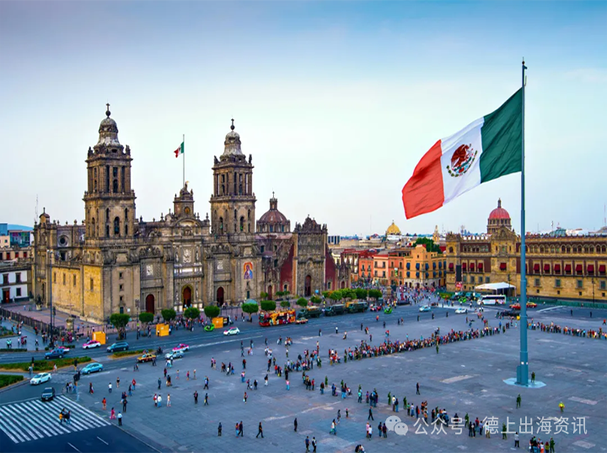
In recent years, Mexico has become one of the most popular destinations for foreign investment in Latin America, thanks to its geographical advantage of being adjacent to the United States, a sound legal system, and abundant resource endowments. For Chinese enterprises planning to "go global" and expand into North America, Mexico serves not only as a commercial bridge connecting North and South America but also as a crucial springboard to enter the market of the United States-Mexico-Canada Agreement (USMCA).
This article compiles key information throughout the entire process of overseas investment in Mexico, breaking down everything from country profiles and investment environments to foreign exchange management and practical tips, packed with valuable insights. It is recommended to save this for future reference.
1. First, understand: Core basics of investing in Mexico
Mexico is located in the southern part of the North American continent, bordering the United States to the north, with a stable political situation and a sound legal system. It is a populous country in Latin America (with a population of 121 million in 2024), an economic powerhouse, and the world's largest trading nation.
Currently, there are nearly 150,000 Chinese expatriates residing in Mexico, where Spanish is the official language and English is the primary foreign language.
In terms of industrial foundation, Mexico has a complete industrial system with diverse sectors and prominent core industries:
Automotive industry: The largest manufacturing sector, ranking as the world's seventh-largest automobile producer and fourth-largest exporter of auto parts;
Energy and minerals: The world's largest producer of silver, with reserves and output of lead, zinc, gold, and other mineral products ranking among the top globally, along with abundant oil and natural gas resources;
Agriculture and food: The origin of crops such as corn and tomatoes, ranking as the world's seventh-largest exporter of food and agricultural products, with high aquatic product yields.
2. Why choose Mexico?
Mexico has become a key investment and cooperation partner for China enterprises in Latin America, primarily due to the following four irreplaceable advantages:
Dual benefits of location and trade agreements: Being a hub connecting North and South America, it is surrounded by the sea on both sides and adjacent to the United States; it has signed free trade agreements with over 50 countries worldwide, including the USMCA and CPTPP, with a high degree of trade liberalization and extremely convenient exports.
Unique resource endowment: It covers various resources such as energy (oil, natural gas), precious metals (gold, silver), and non-ferrous metals, with reserves/production ranking among the world's top, providing ample support for industries like manufacturing and mining.
Low cost + high quality: As the second most populous country in Latin America, it has a young population structure, abundant and low-cost labor; its developed education system and comprehensive vocational training ensure labor productivity meets market demands.
Market potential: Its GDP ranks among the top in Latin America, with a smooth macroeconomic operation; its manufacturing sector (automobiles, electronics, food processing, etc.) is internationally competitive, with complete infrastructure and sound logistics and financial systems across land, sea, and air.
Notably, China has been Mexico's second-largest trading partner for many consecutive years, with extensive cooperation in core areas such as energy, telecommunications, transportation, manufacturing, and mining, laying a solid foundation for collaboration.
3. Key operational points: Core aspects of foreign exchange management for Chinese overseas investments in Mexico 1
(1). Currency exchange rules The official currency is the Mexican peso, which can be freely exchanged with major international currencies such as the US dollar, euro, and Japanese yen. The Chinese yuan cannot currently be directly settled with the peso, and cross-border transactions require conversion through intermediary currencies like the US dollar.
(2). Exchange Rate System and Trends Mexico operates an independent floating exchange rate system where the peso is determined by foreign exchange market supply and demand, with free convertibility for both current and capital accounts.
Exchange Rate Dynamics: Since 2020, the peso has generally appreciated against the US dollar, with an estimated annual appreciation of nearly 20% by 2025. Following the 2024 general election, a slight depreciation occurred. In 2026, volatility is expected to rise significantly due to diverging global monetary policies and the review of the US-Mexico-Canada Agreement (USMCA).
Interest Rate Differential Support: The Central Bank of Mexico has cut interest rates eight times to 7% by 2025. In 2026, it is projected to maintain a relative interest rate differential advantage over the Federal Reserve, providing some support for the peso.
Capital Outflow: US dollars can be freely remitted and received. Corporate profits, dividends, and interest after tax can all be freely remitted. Foreign-funded enterprises may open US dollar accounts at local banks, with minimum account balances set by banks.
Key Taxes: Foreign-funded enterprises must pay a "profit remittance tax" when transferring profits, with rates varying slightly by investment country.
4. Cost Control: Production Factor Prices and Labor Conditions
Before investment, it is essential to accurately assess production factor costs. Mexico's water, electricity, oil, gas, and labor costs exhibit clear regional and tiered differences, as detailed below:
(1). Water, Electricity, Oil, and Gas Prices (2025 data reference)
Mexico implements a tiered pricing system for water, electricity, oil, and gas, with varying rates across states and cities. Prices have risen slightly since 2021 due to energy shortages:
Industrial Energy Prices: A tiered pricing system applies, with prices increasing proportionally to consumption. From 2019 to 2024, industrial electricity prices rose by over 30% cumulatively. Industrial medium-voltage electricity demand averages 1.0576 pesos/kWh (approximately $0.056/kWh), peaking at 2.290 pesos/kWh during peak hours. The northern border industrial zone benefits from natural gas price discounts of 70% compared to U.S.
rates due to offshore outsourcing policies. Energy pricing for residents: Mexico City's residential electricity base rate (<75 kWh) ranges from $0.055 to $0.06/kWh, with summer rates slightly higher than winter. Nationwide, 92-octane gasoline averages 25.65 pesos/liter ($1.37/liter), diesel prices remain comparable to gasoline, and liquefied natural gas stays around $0.54/liter.
Key regional differences: Northern industrial states like Nuevo León and Chihuahua have well-developed energy infrastructure, offering 8%-12% lower prices than southern regions. New energy companies can apply for federal energy subsidies to reduce long-term operational costs.
(2). Wage structures and core requirements:
Wages show significant regional variations—highest in central and northern regions, moderate in eastern areas, and lower in southern and western regions. Job levels: Factory supervisors> production supervisors> production engineers> skilled workers> unskilled workers.
2024 minimum wage: 249 pesos/day in general areas, 375 pesos/day in the northern border free zone (effective January 1, 2024, a 20% increase from 2023). Social Security Costs: Employers must additionally cover employees' social security, housing funds, retirement funds, and vacation/year-end bonuses, accounting for approximately 30% of salaries. Social security contributions are split 75% employer and 25% employee, paid monthly.
Localization Requirements (Key Point!): Local employees must constitute at least 90% of hires; technical experts should primarily be Mexican nationals, with foreign technical/expert personnel limited to 10% (subject to immigration confirmation of local competency). Foreign executives can only be hired after two years of operation, and must oversee local worker training. Enforcement has tightened since 2022, with hefty fines for violations.
5. Compliance Red Lines: Investment Access Restrictions and Regulatory Authorities
Mexico has clear investment access rules requiring early clarification of regulatory bodies and restrictions to avoid compliance risks:
(1). Core Regulatory Authorities Foreign
Investment Authority (Ministry of Economy): Oversees foreign investment registration;
Foreign Affairs Office: Approves foreign investment in restricted areas;
Ministry of Finance and Public Credit: Grants tax registration numbers to foreign enterprises;
National Foreign Investment Committee: Non-profit advisory body for project evaluation and investment guidance.
(2). Key Access Restrictions
Restricted Areas: Border and coastal zones prohibit direct land/real estate purchases by foreign investors, only through trust arrangements (approved by Foreign Affairs Office, valid for up to 50 years).
Equity Restrictions Industries: 10% equity limit: Production cooperatives;
49% equity cap: Explosives/gun trade manufacturing, domestic newspaper printing/distribution, freshwater/coastal fishing, broadcasting, domestic air transport, and 10 other sectors.
Pre-approval Requirements: Intending to hold over 49% equity in regulated industry entities (e.g., port services, airport concessions, private education, legal services); Direct/indirect acquisition of over 49% equity in Mexican enterprises exceeding 22.647 billion pesos (2022 standard, approximately $1.117 billion) in assets (annual standards are available in the Federal Gazette or Ministry of Economy website).
6. Investment Methods: Available Options and Precautions
Mexico's Foreign Investment Law imposes fewer restrictions on foreign investment structures. Common methods include:
Establishing entities: Representative offices, branches, subsidiaries;
Investment forms: Foreign exchange, equipment, technology investments;
Purchasing fixed assets, expanding/migrating factories, adding production lines (excluding restricted industries);
Key considerations: Imported second-hand equipment requires approval from the Ministry of Economy; Given the highly competitive Mexican manufacturing sector, adopting advanced technology equipment is recommended to enhance competitiveness.
7. Basic Registration Requirements: Clarifying Core Conditions to Avoid Initial Barriers
The core requirements for Mexican company registration focus on four dimensions: entity qualification, address, capital, and business scope. Foreign enterprises should pay special attention to identity verification and compliance filing requirements:
(1) Number and requirements of shareholders: SA companies must have at least 2 shareholders (natural persons/legal entities acceptable), with no nationality restrictions. Natural person shareholders must provide passport copies and address proof for the past 3 months (utility bills, bank statements, etc.).
(2) Capital requirements: No mandatory minimum capital limit exists, but a benchmark of 50,000 pesos (approximately RMB 25,000) is typically recommended in practice, with no capital verification required.
(3) Registered Address Requirements: A genuine physical address within Mexico must be provided (postal mailboxes are not acceptable). A lease agreement or property ownership certificate must be submitted as proof of address. The registered address may differ from the actual business address. For foreign-funded enterprises that have not yet determined their actual office location, they may entrust an agency to provide a compliant virtual address.
(4) Company Name and Business Scope:
The company name must comply with naming regulations, and the suffix must match the company type (e.g., S.A. de C.V. for a joint-stock company, S. de R.L. for a limited liability company). It is recommended to prepare 3-5 alternative names (in English or Spanish) to avoid rejection due to duplicate names.
Business scope: Specific business activities must be detailed (e.g., "automotive parts production and sales," "import and export of electronic products"), avoiding broad descriptions, as tax registration requires categorization based on the business scope. Special industries (manufacturing, food, healthcare, etc.) require subsequent submission of industry permits.
Conclusion:
Leveraging the benefits of the USMCA agreement, geographical advantages, and cost advantages, Mexico has become an important choice for Chinese enterprises to establish operations in North America. However, prior to investment, special attention must be paid to compliance issues such as labor localization, equity restrictions, and foreign exchange taxes. It is recommended to consult professional agencies in advance to understand local policy details and mitigate potential risks based on one's own industrial needs.